
Expense Categories Explained: Why They Matter More Than You Think
May 13th, 2026 | Small Business Resources
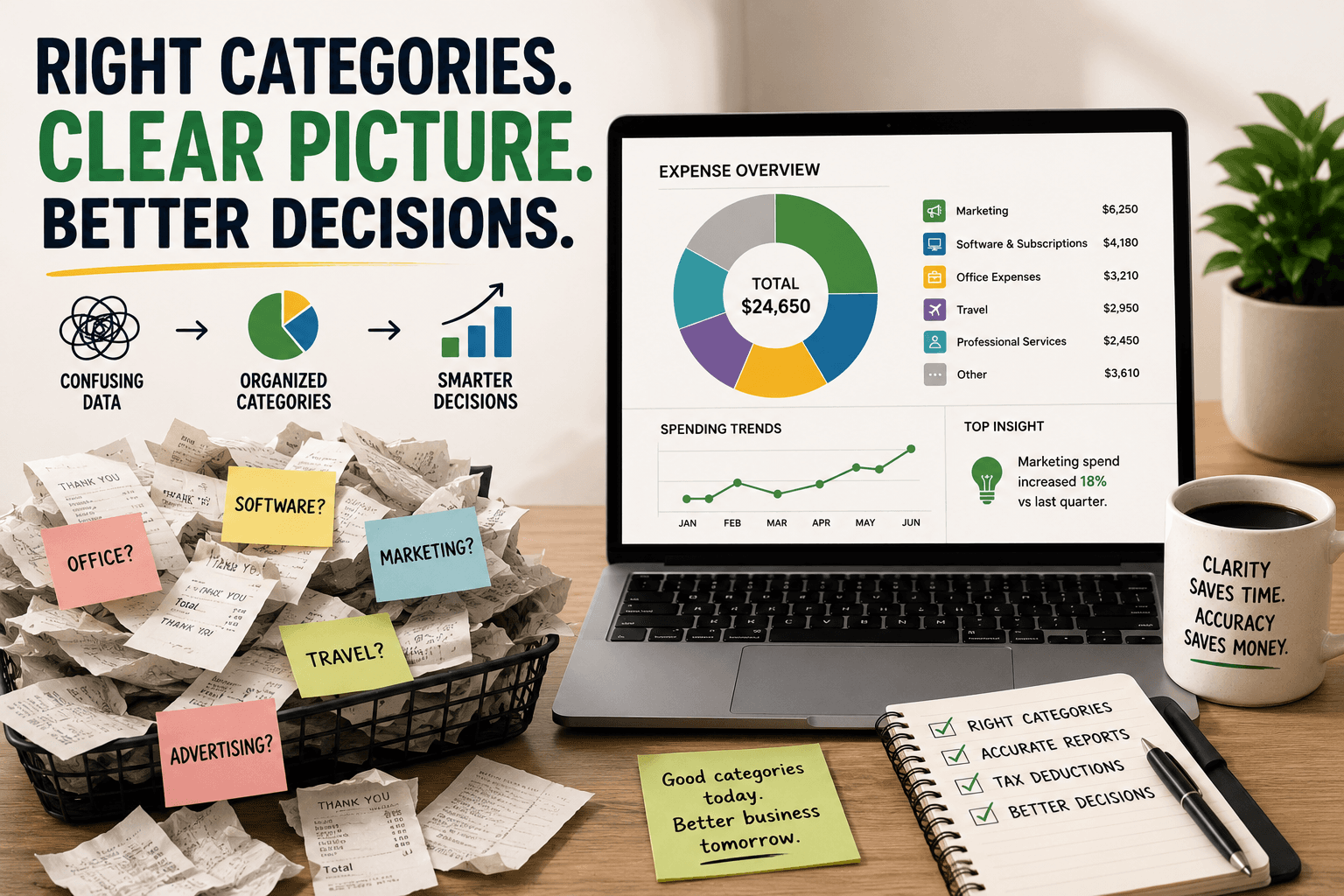
Expense categories are not just for an organization. They directly impact your financial accuracy, tax deductions, and decision-making. Poor expense management leads to miscategorized transactions, inaccurate reports, and missed savings. When categories are structured correctly, you gain clarity, control, and confidence in your business finances.
The Mistake That Skews Your Entire Financial Picture
Most business owners think categorizing expenses is a minor task.
Something to clean up later.
Something that does not really impact the bigger picture.
But here is the reality.
If your expense categories are wrong, everything built on top of them is wrong too.
Your reports.
Your tax deductions.
Your understanding of where your money is going.
This is not just an organization issue.
It is an expense management problem that affects every financial decision you make.
What Expense Categories Actually Do
Expense categories are the structure behind your financial data.
They define how your spending is grouped, tracked, and reported.
Without them, your expenses are just a list of transactions with no meaning.
With them, patterns emerge.
You can see how much you are spending on marketing versus operations. You can track trends over time. You can identify areas where costs are increasing without realizing it.
Strong expense management depends on this structure.
Because without it, you are not managing expenses.
You are reacting to them.
Where Things Go Wrong
Most categorization issues do not come from misunderstanding.
They come from inconsistency.
One month, a software expense is categorized as “office expense.” The next month, it is “subscriptions.” Over time, your data becomes fragmented.
Now your reports cannot be trusted.
This is one of the most common reasons businesses feel like their numbers are off. The data exists, but it is not usable.
And when reports are unreliable, decision-making slows down.
If you have ever questioned your numbers, this is often the root cause.
Because categorization is the foundation of that organization.
The Hidden Cost of Poor Categorization
The impact of poor categorization is not always obvious.
But it shows up in three critical areas.
First, tax deductions.
If expenses are categorized incorrectly, you may miss deductions or misreport them entirely. This can either cost you money or create risk during an audit.
Because documentation and categorization go hand in hand.
Second, financial visibility.
If your categories are inconsistent, you cannot accurately track where your money is going. That means you might be overspending in one area without realizing it.
Third, time.
When categories are not set up correctly from the start, you spend more time fixing them later. What should take minutes turns into hours of cleanup.
Because delays and inconsistencies often go together.
What Good Expense Management Looks Like
When expense categories are structured correctly, everything becomes easier.
Transactions are categorized consistently. Reports reflect reality. Reviews become faster and more accurate.
Instead of questioning your numbers, you trust them.
Good expense management means your categories align with how your business actually operates and how your taxes are reported.
They are not random labels.
They are intentional.
A Real-World Example
A small business owner believed their expenses were evenly distributed across operations and marketing.
But after cleaning up their categories, they discovered something different.
Marketing costs were nearly double what they expected.
The issue was not overspending alone. It was miscategorization. Some marketing expenses had been grouped under general business costs, hiding the true total.
Once corrected, they were able to adjust their budget and improve profitability.
That level of clarity only comes from accurate expense management.
How to Fix Your Expense Categories
You do not need dozens of categories.
You need the right ones.
Start by aligning your categories with common tax classifications and how you actually spend money in your business. Then apply them consistently.
Review your categories regularly. If something does not fit, adjust it. The goal is not perfection. It is clarity.
And most importantly, avoid letting expenses sit uncategorized.
That is where confusion begins.
Why This Matters More Than You Think
Expense categories are not just about keeping things tidy.
They are about creating a system you can rely on.
When your categories are accurate, your reports become meaningful. Your tax preparation becomes easier. Your decisions become more informed.
Without that structure, you are operating with incomplete information.
And incomplete information leads to costly mistakes.
The Bottom Line
If your expense categories are inconsistent, your financial picture is incomplete.
Fixing your expense management system starts with fixing your structure.
Once your categories are clear and consistent, everything else becomes easier to manage, review, and improve.
If you are ready to simplify your expense management and bring clarity to your finances, start with a system that automatically categorizes and organizes your expenses.
Start your free trial and take control of your financial data.
Share This Article


Popular

September 23rd, 2026

March 9th, 2022


June 26th, 2020


August 23rd, 2022