
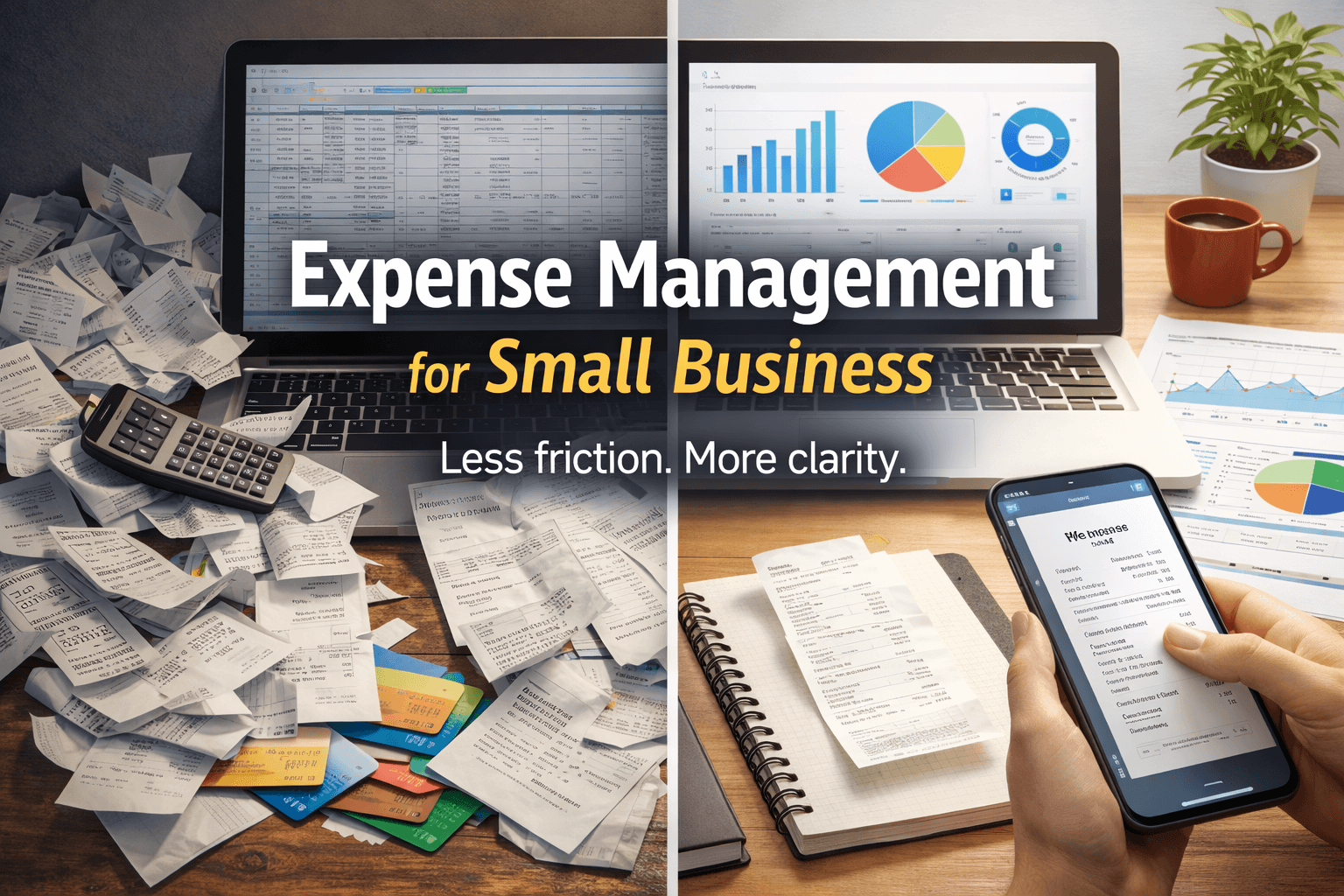
Let’s just say it out loud.
Most small business owners do not hate their business. They hate the accounting part of their business.
It is not the work you enjoy. It is not why you started. And it is definitely not how you want to spend your time.
It is the receipts, the categories, the reports, and the constant feeling that you are one step behind.
But here is the reality. You do not get to opt out of it.
That is why expense management for small business matters so much. Not because you want to become an accountant, but because you need a system that keeps your business running without adding more stress to your day.
The Misconception About “Getting Better at Accounting”
There is a common belief that if you run a business, you should be good at managing the numbers.
At a high level, that is true. You should understand your financial position and make informed decisions.
But somewhere along the way, that idea gets distorted.
It turns into the belief that you should enjoy bookkeeping, manually track every expense, and stay on top of every detail yourself.
That is not realistic for most business owners.
You do not need to love accounting. You need a system that removes it as a manual burden. The goal of expense management for small business is not to turn you into a bookkeeper. It is to give you clarity without requiring constant effort.
Why Accounting Feels So Frustrating
Accounting is not just tedious. It disrupts how you naturally work.
You spend your day selling, building, creating, and working with clients. Then suddenly, you have to stop and shift into a completely different mode. You are sorting receipts, categorizing expenses, and trying to remember what a transaction was for.
That kind of context switching is mentally draining.
For example, imagine finishing a productive morning working with clients, only to spend the afternoon digging through transactions and trying to reconcile expenses from weeks ago. The work feels disconnected from the value you are creating.
This is why many business owners struggle with expense management for small business. It does not fit into their workflow.
The Real Problem Is Workflow, Not Discipline
Most accounting challenges are not caused by lack of discipline. They are caused by systems that do not align with how people actually operate.
Traditional expense management expects you to set aside time to review, organize, and reconcile everything after the fact. Usually at the end of the week or month, when you are already mentally drained.
So what happens?
You avoid it.
And that avoidance creates a cycle. Expenses pile up, the task becomes more overwhelming, and the stress increases. Eventually, it turns into a last-minute scramble during tax season.
The issue is not that you need to try harder. It is that your system relies too heavily on effort.
What Expense Management Should Actually Feel Like
Effective expense management for small business should not feel like a separate task.
It should feel like part of your normal workflow. Something that happens naturally as you go about your day.
Instead of saving receipts to deal with later, they should be captured in the moment. Instead of manually entering data, it should be extracted automatically. Instead of reviewing everything at once, your records should stay up to date continuously.
For example, when you make a purchase, capturing that expense should take seconds, not minutes. The details should be stored and categorized without requiring you to revisit it later.
When this happens, expense management stops being a chore and becomes something that simply stays handled.
You Do Not Hate Accounting. You Hate Friction
Most business owners are not avoiding accounting because they are careless. They are avoiding it because the process is frustrating.
If capturing an expense takes too long, requires too many steps, or interrupts your workflow, you will naturally put it off.
That is not a personality flaw. It is a system problem.
Reducing friction is the key to improving expense management for small business. When the process becomes simple and fast, consistency follows naturally.
What Actually Matters in Expense Management
You do not need perfect books or endless reports.
What you need is clarity.
You need to know where your money is going, have organized records when you need them, and feel confident when it is time to make financial decisions or prepare for taxes.
For example, instead of spending hours preparing documents at year end, you should be able to access organized records instantly. Instead of guessing whether you can afford an investment, you should be able to quickly review your financial position.
That is the real outcome of effective expense management.
How Neat Simplifies the Process
This is where a system like Neat changes the experience.
Rather than requiring manual effort at every step, it simplifies and automates the process. You can capture receipts as they happen, and the system extracts the data and categorizes the expense for you.
Everything is stored in one place, making it easy to search, review, and generate reports when needed.
For example, instead of trying to remember what a transaction was for weeks later, the receipt and details are already attached and organized. Instead of building reports manually, you can quickly view your expenses by category and timeframe.
This reduces the need for constant effort and makes expense management for small business far more manageable.
What Changes When It Becomes Easy
When expense management fits into your workflow, everything improves.
You stay up to date without thinking about it. You stop avoiding your financials. You make faster decisions because you have clear information.
And perhaps most importantly, you reduce the stress that comes with uncertainty.
This shift does not happen because you suddenly become more disciplined. It happens because the process no longer works against you.
The Confidence of Being Organized
There is a big difference between feeling like things are probably fine and knowing they are.
When your expenses are organized and accessible, you have confidence. You are not second-guessing your numbers or scrambling to find information.
You know where you stand.
That clarity allows you to focus on growing your business instead of managing your records.
Final Thought
You do not need to become someone who loves accounting.
You need a system that removes it as a burden.
Expense management for small business should support your work, not interrupt it. It should give you clarity without demanding constant attention.
Tools like Neat exist to make that possible, so you can spend less time managing expenses and more time running your business.
Share This Article


Popular

September 23rd, 2026

March 9th, 2022


June 26th, 2020


October 2nd, 2026