
Almost every small business owner has had the same moment.
You decide it is finally time to get organized.
You create folders.
Build a spreadsheet.
Download a new app.
Set reminders to track expenses consistently.
Maybe for a few weeks, everything works perfectly.
Receipts get uploaded. Expenses are categorized. You feel in control.
Then real life happens.
Work gets busy. Receipts pile up. One missed day turns into two weeks. The system becomes something you are “behind on,” and eventually it gets abandoned altogether.
This cycle happens so often that many business owners start believing they simply are not organized people.
But the problem usually is not discipline.
And it usually is not effort.
The problem is that most receipt systems are built around ideal behavior instead of real behavior.
Why Most Receipt Systems Eventually Fail
Many receipt tracking systems sound good in theory.
The problem is what they require from the user.
Most systems depend heavily on consistency, memory, and manual effort. They ask people to stop what they are doing, switch context, and complete multiple small administrative tasks throughout the day.
At first, that feels manageable.
Over time, it becomes exhausting.
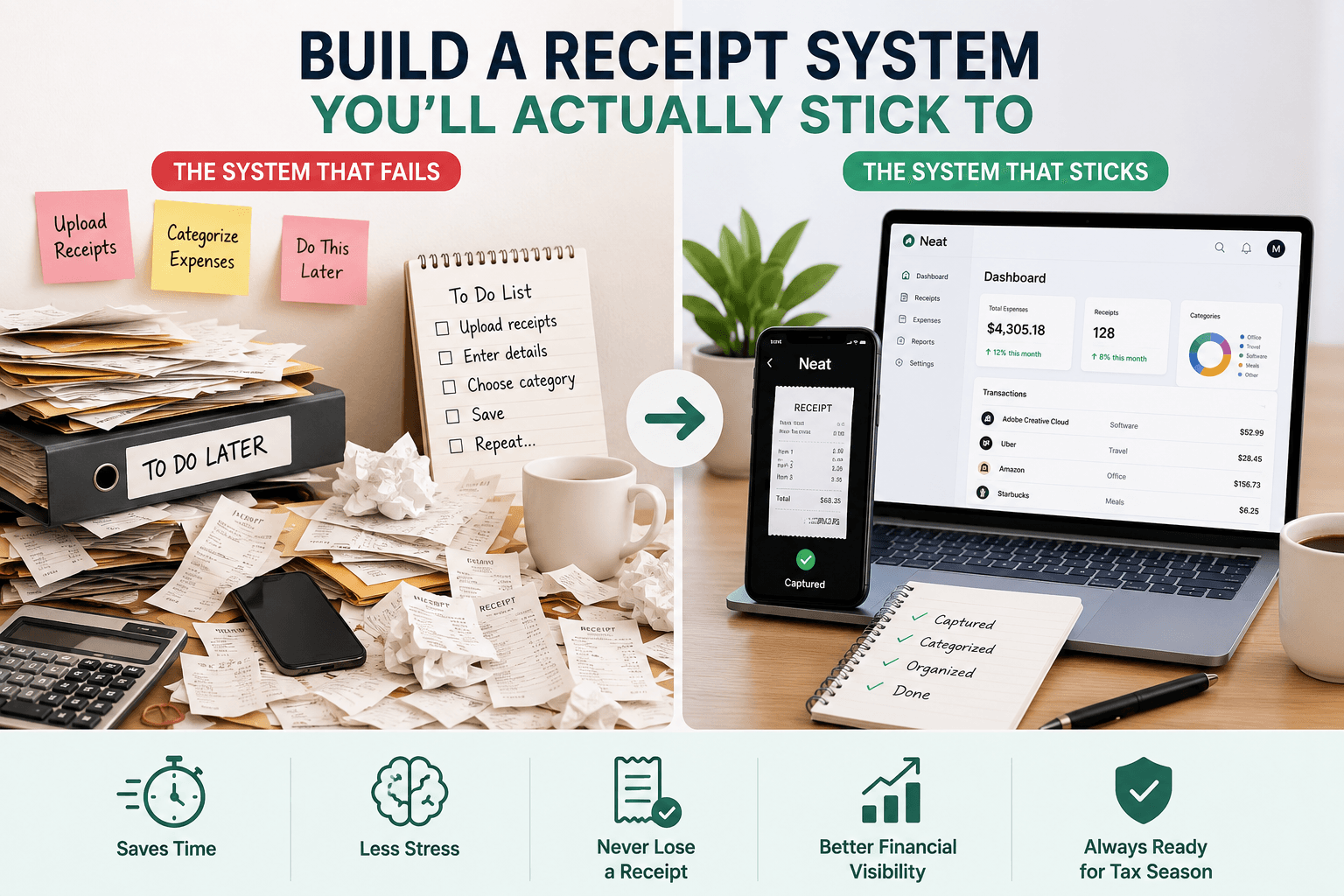
A typical workflow might look like this:
Open the app.
Upload the receipt.
Enter details manually.
Choose the right category.
Save it.
Repeat for every expense.
Individually, none of those steps feel overwhelming.
But when repeated constantly across a busy workweek, they create friction.
And friction is what kills consistency.
The more effort a process requires, the more likely people are to postpone it.
That postponement is what eventually creates clutter, backlog, and financial chaos.
The Biggest Weakness in Most Systems: Memory
One of the most common reasons receipt systems fail is because they rely on people remembering to do things later.
Later tonight.
Later this week.
Later when work slows down.
But memory is not a reliable organizational strategy.
Small business owners already manage an overwhelming number of responsibilities every day. Client work, meetings, invoices, sales, customer issues, marketing, hiring, and operations all compete for attention constantly.
Receipts become just another unfinished task floating around mentally.
And unfinished tasks tend to create ongoing stress because the brain keeps trying to remind you they still exist.
The result is predictable.
Receipts accumulate.
Expenses go uncategorized.
Reports become incomplete.
And eventually the entire system feels too overwhelming to catch up on.
Why Good Habits Are Really About Reducing Friction
Many people assume staying organized is about discipline.
But most successful habits are not built through willpower alone.
They are built by making the desired behavior easier.
The less effort something requires, the more consistently it happens.
That principle matters enormously for financial organization.
If tracking receipts feels complicated, time-consuming, or mentally draining, people will naturally avoid it even when they know it is important.
That does not mean they are lazy.
It means the system creates too much resistance.
Strong organizational systems remove resistance instead of depending on motivation.
Because motivation changes daily.
Low-friction systems remain usable even on busy days.
What a Receipt System You’ll Actually Use Looks Like
The best receipt systems are not necessarily the most advanced.
They are the ones that fit naturally into real life.
A system people consistently stick with usually has three important qualities.
First, it happens immediately.
There is no “I’ll do this later.”
The receipt gets handled in the moment instead of becoming future cleanup.
Second, it requires very little thinking.
The user does not need to make dozens of small decisions, manually enter data, or remember complicated processes.
The easier the workflow feels, the more likely it becomes a natural habit.
Third, the system finishes the task completely.
Not partially.
Not “saved for later.”
Done.
That distinction matters because unfinished tasks continue occupying mental space.
A truly effective system removes the task entirely instead of simply postponing it.
Why Simplicity Is More Powerful Than Discipline
Many business owners believe they need to become more disciplined with expense tracking.
In reality, most people do not need more discipline.
They need systems that require less effort.
The simpler a process becomes, the more sustainable it becomes long term.
That is why highly effective organizational habits often feel almost automatic.
The process becomes so easy that it stops feeling like work.
And when something no longer feels difficult, consistency becomes much easier to maintain.
The goal is not to create the perfect workflow on paper.
The goal is to create a workflow that still works during busy weeks, stressful days, and real-world distractions.
Because those are the moments where most systems break down.
What the Ideal Receipt Habit Actually Looks Like
The strongest receipt habits are incredibly simple.
A purchase happens.
The receipt gets captured immediately.
The information is processed automatically.
The task is finished.
There is no backlog waiting for the weekend.
No monthly cleanup session.
No pile of receipts sitting in a drawer waiting to be organized someday.
The simpler the process feels, the more likely it becomes part of everyday behavior instead of a task that constantly gets postponed.
That simplicity creates consistency.
And consistency is what keeps businesses organized year-round.
How Neat Helps Build a System That Actually Sticks
Neat is designed around how people actually behave, not how they wish they behaved.
Instead of creating more manual work, Neat helps reduce the effort required to stay organized consistently.
Receipts can be captured immediately as expenses happen. Data is extracted automatically, expenses are categorized consistently, and everything stays searchable and organized in one place.
Because much of the process happens automatically, there are fewer steps to remember and fewer opportunities for procrastination to build up.
That matters because systems people stick with are usually the systems that feel easiest to maintain.
The less friction involved, the more naturally the habit fits into daily life.
The Long-Term Benefit of a System That Works
When receipt organization becomes automatic and consistent, the benefits extend far beyond cleaner records.
Businesses stay organized throughout the year instead of scrambling during tax season.
Reports become more reliable.
Financial visibility improves.
Decision-making becomes easier because the numbers are trustworthy.
And perhaps most importantly, business owners stop carrying the mental burden of unfinished administrative work.
That creates more focus, more confidence, and far less stress.
Not because people suddenly became more disciplined.
Because the system finally aligned with how real life actually works.
Final Thought
The best receipt system is not the one with the most features.
It is the one you will actually continue using consistently.
If a system requires too much effort, too much memory, or too much manual work, it eventually becomes something people avoid.
Strong financial organization comes from reducing friction, simplifying behavior, and making consistency feel natural instead of exhausting.
Neat exists to help make that possible by turning receipt tracking into something automatic, organized, and easy to maintain long term.
Share This Article


Popular

September 23rd, 2026

March 9th, 2022


June 26th, 2020


October 2nd, 2026