
How to Spot Waste in Your Business Without a Finance Degree
May 11th, 2026 | Small Business Resources, Uncategorized
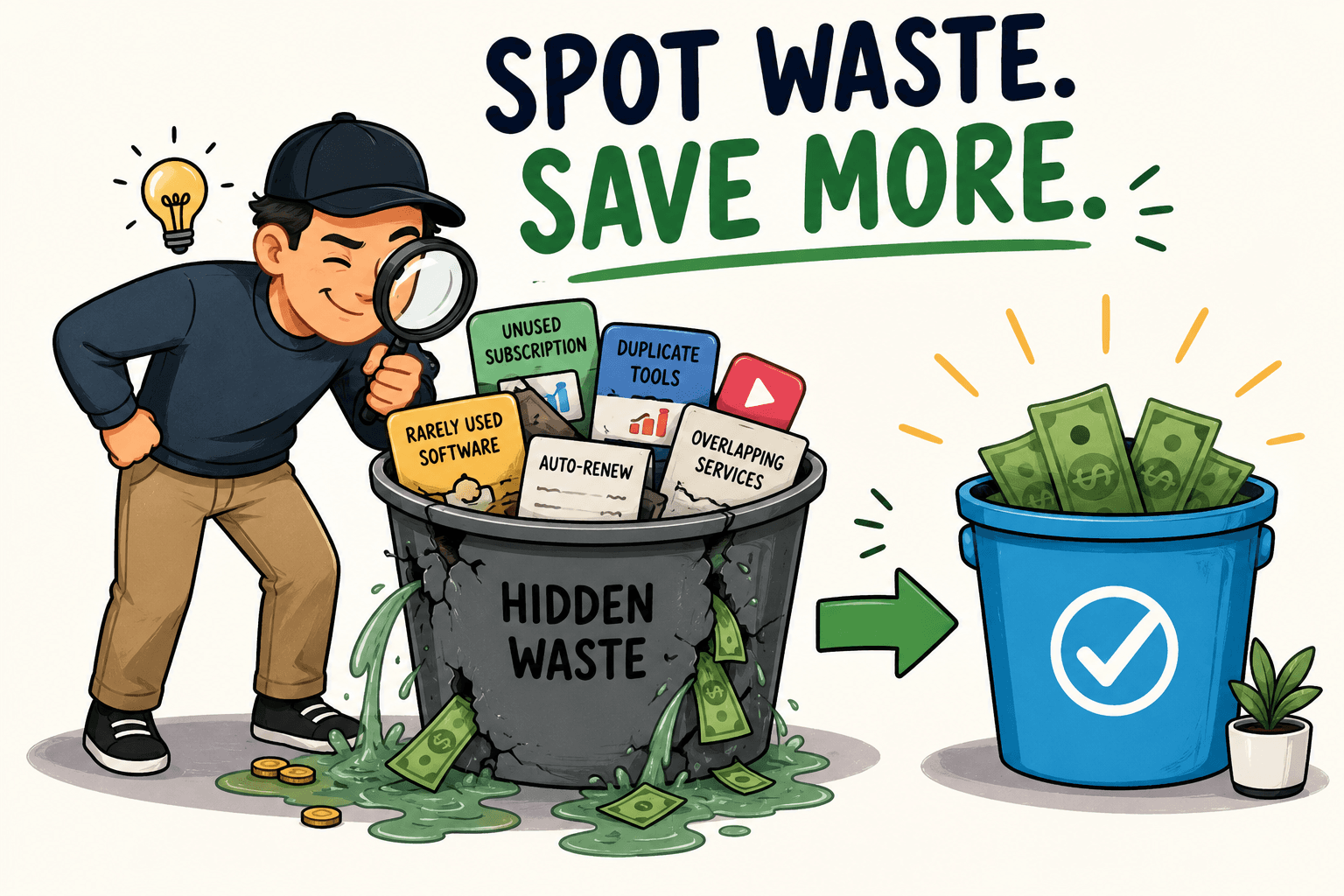
Most small business owners assume you need financial expertise to find waste in your business.
You don’t.
You do not need complex models, advanced reports, or a finance background. What you need is visibility and the ability to recognize patterns.
Because waste in a business rarely hides. It just blends in.
Understanding how to spot waste in your business is less about technical knowledge and more about seeing your expenses clearly and asking the right questions.
Why Waste Doesn’t Look Like Waste
If waste were obvious, it would be easy to eliminate.
It would show up as large, unnecessary expenses or clearly bad decisions. But in reality, waste looks ordinary. It shows up as things that feel familiar, justified, or too small to worry about.
For example, a software subscription that costs $30 per month may not seem significant. But if it is rarely used, or if another tool already provides the same function, it becomes a quiet drain on your business.
Waste often sounds like:
“We’ve always used this.”
“It’s not that expensive.”
“We might need it.”
Because it feels normal, it goes unchallenged. That is why learning how to spot waste in your business starts with questioning what feels routine.
The First Signal: You’ve Stopped Questioning It
One of the clearest indicators of waste is when an expense runs on autopilot.
Over time, many costs become accepted simply because they have been there for a while. Subscriptions renew, vendors continue billing, and tools remain in place without review.
For instance, a business might continue paying for a platform that was critical a year ago but is no longer actively used. Without revisiting that decision, the expense becomes permanent.
If you want to improve how to spot waste in your business, start by reviewing anything you have not questioned recently.
The Second Signal: It Doesn’t Tie to an Outcome
Every expense in your business should serve a purpose.
It should either generate revenue, save time, improve efficiency, or support operations in a meaningful way.
If you cannot clearly explain what an expense does for your business, that is a red flag.
For example, a marketing tool that “might help” but has not produced measurable results, or a service you “barely use” but continue paying for, are both signs of potential waste.
Clarity around outcomes is essential when learning how to spot waste in your business. If the value is unclear, the expense deserves attention.
The Third Signal: Overlapping Tools and Services
Overlap is one of the most common and easiest forms of waste to identify.
It often happens gradually. You add a tool to solve a new problem, test a different platform, or upgrade a system. Over time, multiple tools begin to serve similar functions.
For example, a business might use one tool for invoicing, another for expense tracking, and a third for reporting, even though one platform could handle all three.
These overlaps are rarely intentional, but they create unnecessary costs.
When you understand how to spot waste in your business, identifying overlap becomes one of the quickest ways to reduce expenses without impacting operations.
The Fourth Signal: Costs That Grow Quietly Over Time
Some of the most significant waste comes from expenses that increase gradually.
A subscription plan gets upgraded. Advertising spend increases month over month. Software pricing rises without much notice.
Because these changes happen slowly, they do not feel urgent.
For example, a tool that started at $29 per month might now cost $99 due to added features or usage tiers. Without reviewing that change, the increased cost becomes normalized.
Tracking growth in expense categories is a key part of understanding how to spot waste in your business. Anything that is increasing deserves a closer look.
The Fifth Signal: You Wouldn’t Choose It Again Today
One of the simplest and most effective tests is this:
If you did not already have this expense, would you choose it again today?
If the answer is no, or even “probably not,” it is worth revisiting.
For instance, a service that once solved a major problem may no longer be relevant as your business evolves. But because it is already in place, it continues without question.
This mindset shift is powerful. It forces you to evaluate expenses based on current value, not past decisions.
Why Most Business Owners Don’t Do This
The reason most people struggle with how to spot waste in your business is not lack of awareness. It is lack of visibility and time.
To identify waste, you need clear data, organized expenses, and the ability to review them efficiently. Without those, the process feels overwhelming.
So the default assumption becomes, “Everything is probably fine.”
Unfortunately, that assumption is what allows waste to persist.
The Problem With Guessing
When you do not have a clear view of your expenses, you are forced to rely on instinct.
And instinct can lead to poor decisions.
You might cut costs that are actually valuable while keeping expenses that are not contributing to your business. You may miss obvious inefficiencies simply because you cannot see them.
Guessing is not a strategy. Visibility is.
How Neat Makes Waste Easier to Spot
This is where a system like Neat becomes essential.
Instead of scattered data across multiple platforms, everything is centralized. Receipts, transactions, categories, and reports are all organized in one place.
This allows you to quickly scan your expenses and identify patterns.
For example, you can easily see which categories are growing, where your money is going, and which expenses look out of place. Instead of digging through statements, you can review clear, structured reports that highlight opportunities for improvement.
This makes how to spot waste in your business far more practical and far less time-consuming.
The Power of Small Fixes
You do not need to overhaul your entire business to see results.
Often, identifying and correcting just a few areas of waste can have a meaningful impact.
Removing unused subscriptions, consolidating tools, or adjusting spending in one category can free up cash, improve margins, and increase efficiency.
These small changes add up quickly and create momentum.
Final Thought
Waste in your business is not hidden because it is complicated.
It is hidden because it feels familiar.
Once you have visibility into your expenses, spotting it becomes much easier. You do not need advanced financial skills. You just need clarity and a willingness to question what has become routine.
Tools like Neat exist to give you that clarity, so you can clean up inefficiencies, improve margins, and run your business with greater confidence. Start your Free Trial Today!
Share This Article


Popular

September 23rd, 2026

March 9th, 2022


June 26th, 2020


August 23rd, 2022