
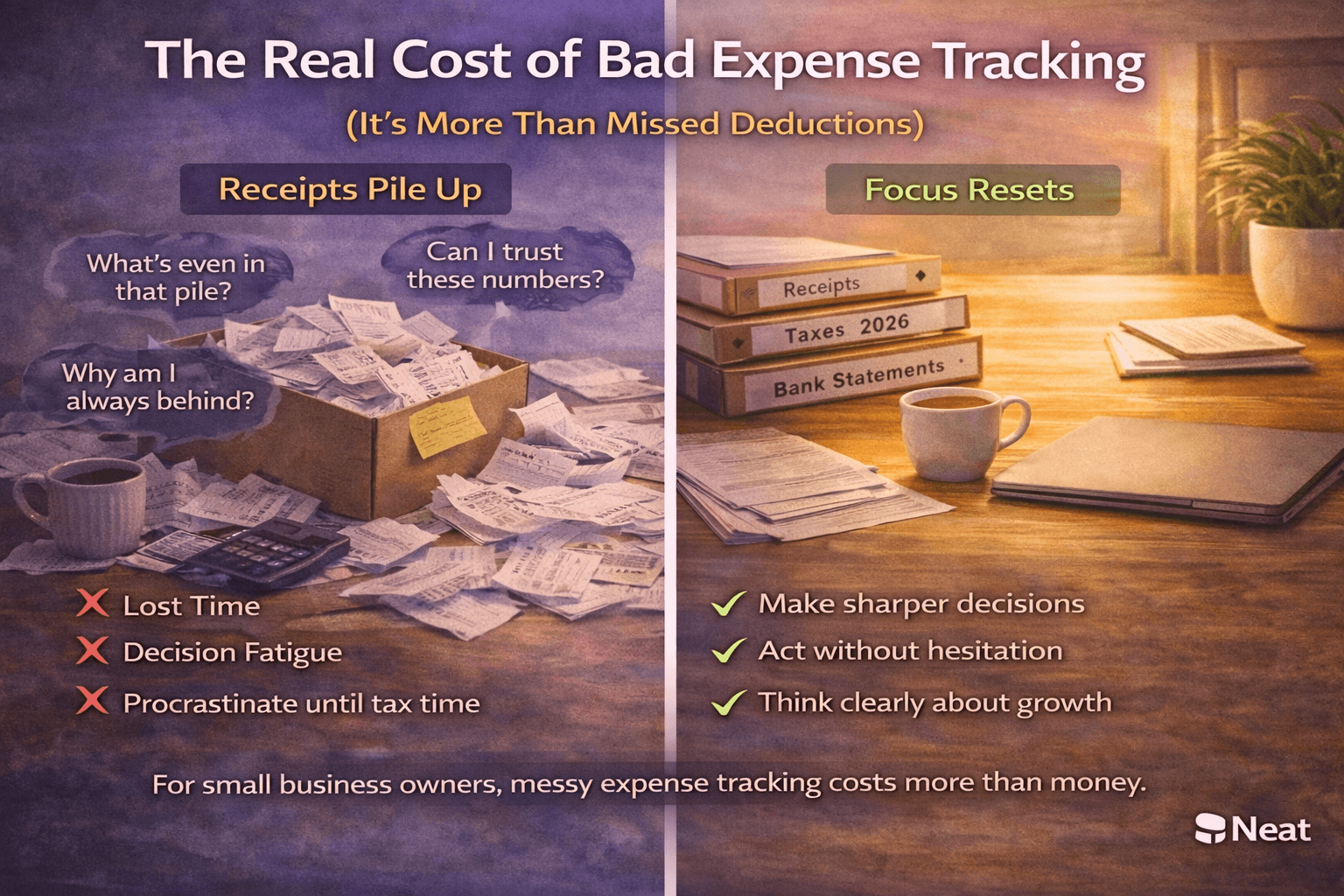
The Real Cost of Bad Expense Tracking (Hint: It’s Not Just Money)
When people talk about expense tracking, they usually frame it as a numbers problem.
Missed deductions. Incorrect totals. Accounting errors.
But for very small businesses, the real cost of bad expense tracking isn’t financial.
It’s personal.
It shows up as stress.
As distraction.
As that low-grade anxiety humming in the background while you’re trying to do real work.
Bad expense tracking doesn’t just hurt your books.
It quietly drains your energy.
The Myth: “I’ll Fix It Later”
Every tiny business starts with good intentions.
You’ll save receipts.
You’ll sort them monthly.
You’ll clean it all up before tax time.
And then reality kicks in.
A client deadline runs late.
Another project comes in.
Life happens.
Receipts pile up in wallets, inboxes, glove compartments, screenshots, and shoeboxes. The system that was supposed to be “temporary” becomes permanent.
That’s when the real cost starts to compound.
Cost #1: Decision Fatigue
Every untracked expense is a tiny open loop in your brain.
“Did I log that?”
“Was that personal or business?”
“Can I deduct this?”
Multiply that by dozens or hundreds of transactions, and suddenly your mental bandwidth is gone.
You’re spending brainpower remembering the past instead of planning the future.
For a two-person business, that’s deadly.
Cost #2: Lost Time (In the Worst Possible Moments)
Bad expense tracking doesn’t steal time evenly.
It steals time all at once.
Usually:
- Right before taxes
- Right before a meeting with an accountant
- Right when you should be focused on growth
What could have been a few seconds per receipt turns into hours of cleanup.
That’s not just inefficient.
It’s demoralizing.
Cost #3: Stress You Don’t See Until It’s Gone
Here’s something small business owners don’t realize until they fix it:
Living with financial clutter creates constant background stress.
You might not feel it consciously, but it’s there.
- Hesitating before making purchases
- Avoiding your books
- Procrastinating decisions
When expenses aren’t handled, everything feels heavier.
Cost #4: Missed Opportunities
When you don’t know where your money is going, you hesitate to invest.
You delay:
- Hiring help
- Upgrading tools
- Saying yes to new opportunities
Not because you can’t afford it, but because you’re unsure.
Uncertainty is expensive.
Cost #5: The “I’ll Deal With It Myself” Trap
Many founders assume expense tracking is something they should be able to handle manually.
So they try:
- Spreadsheets
- Email folders
- Notes apps
- Bank statements
All of these technically work.
None of them work well.
The effort required guarantees inconsistency, and inconsistency guarantees cleanup later.
What Good Expense Tracking Actually Buys You
Good expense tracking doesn’t just organize money.
It buys back clarity.
When it works properly:
- Expenses are captured automatically
- Records are always up to date
- Tax prep becomes boring (in a good way)
- Decisions feel easier
You stop thinking about expenses entirely.
That’s the goal.
Where Neat Changes the Equation
Neat exists because tiny teams don’t have time to babysit systems.
Instead of asking you to remember, organize, and reconcile later, Neat works in real time:
- Snap a receipt when it happens
- Automatically categorize it
- Store it safely and accessibly
- Generate clean, tax-ready reports when needed
No cleanup phase.
No panic season.
No mental clutter.
Bad expense tracking costs you more than money.
Good expense tracking gives you peace of mind.
The Hidden ROI
The return on good expense management isn’t found on a spreadsheet.
It shows up as:
- Less stress
- Faster decisions
- Better sleep
- More confidence running your business
For a small team, that’s priceless.
Final Thought
If expense tracking feels overwhelming, it’s not because you’re bad at business.
It’s because you’re using tools designed for someone else’s reality.
Fixing it doesn’t require more discipline.
It requires the right system.
Neat doesn’t just organize expenses.
It removes a quiet tax you’ve been paying with your time, focus, and energy.
And once it’s gone, you’ll wonder how you ever worked without it.
Share This Article


%20When%20people%20talk%20about%20expense%20tracking%2C%20they%20usually%20frame%20it%20as%20a%20numbers%20problem.%20Missed%20deductions.%20Incorrect%20totals.%20Accounting%20errors.%20But%20for%20very%20small%20businesses%2C%20the%20real%20cost%20of%20bad%20expense%20tracking%20isn%E2%80%99t%20financial.%20It%E2%80%99s%20personal.%20It%20shows%20up%20as%20stress.%20As%20distraction.%20%5B%26hellip%3B%5D%3C%2Fp%3E%0A&media=https://neat-cms-prod.s3.amazonaws.com/wp-content/uploads/2026/02/real-cost.png)

Popular


March 9th, 2022


June 26th, 2020


August 23rd, 2022