
Where Your Money Actually Goes (And Why It’s Not What You Think)
April 24th, 2026 | Small Business Resources
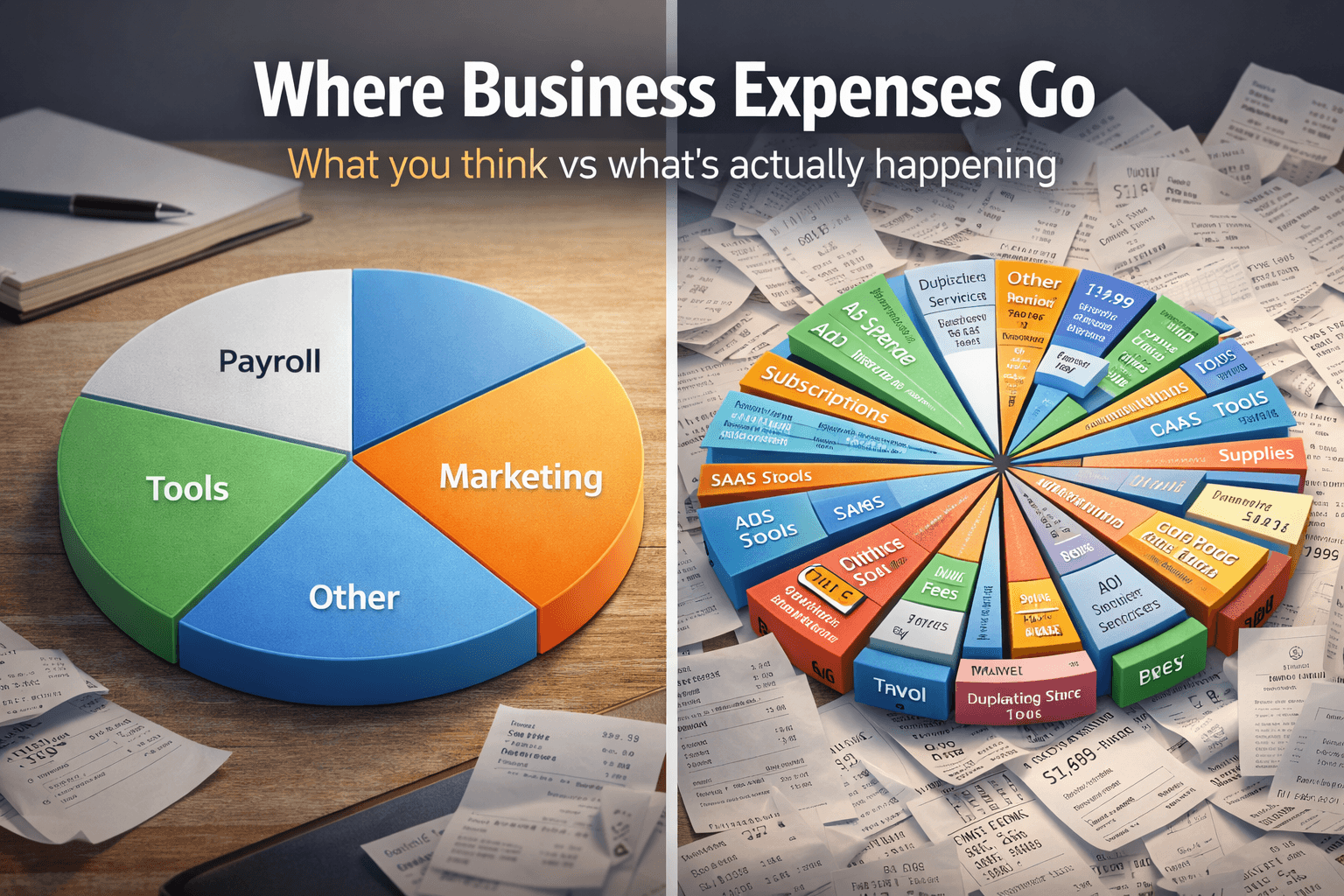
Ask most small business owners where their money goes, and you will get confident answers.
Marketing. Tools. Payroll. Operating costs.
It sounds reasonable. And at a high level, it often is.
But when you look closer, those answers are usually incomplete. Not wildly wrong, but wrong enough to impact decisions, margins, and growth.
Because what most business owners think is happening with their spending and where business expenses go in reality are often two very different things.
The Story You Tell Yourself About Your Spending
Every business owner carries a mental model of their finances.
You might believe that software costs are relatively low, that marketing is under control, or that most of your expenses are necessary and optimized.
The problem is that these beliefs are rarely built from actual data. They are built from memory.
And memory is selective.
For example, you are far more likely to remember a large one-time purchase than a dozen small recurring charges. You remember the expense that felt painful, not the ones that quietly slipped by.
Over time, this creates a distorted picture of where business expenses go.
Why Your Brain Misses the Real Numbers
Human memory is not designed to track detailed financial activity.
It prioritizes what stands out. Big purchases, recent transactions, or anything that created friction at the time.
What it ignores are the patterns that matter most in small business finances. Small recurring costs, older subscriptions, incremental price increases, and one-off purchases that seem insignificant on their own.
For instance, a business owner might clearly recall spending $2,000 on a new piece of equipment, but completely overlook $300 per month in combined software subscriptions.
Over a year, that “invisible” spending adds up to $3,600. More than the equipment they remember so clearly.
That disconnect is at the core of misunderstanding where business expenses go.
The Slow Drain of Small, Recurring Costs
Most businesses do not lose money through dramatic mistakes. They lose it gradually.
A $12 subscription here. A $29 upgrade there. A $79 tool added to solve a short-term problem. A $149 service that seemed useful at the time.
Individually, none of these feel significant. They are easy to justify and easy to ignore.
But collectively, they can represent thousands of dollars each year.
For example, a small business using five or six different tools across marketing, operations, and finance may not realize how much overlap exists. Two tools might perform similar functions, or a premium plan might include features that are never used.
Without clear visibility, these costs quietly accumulate.
The Subscription Trap Most Businesses Fall Into
Subscriptions are one of the biggest blind spots in understanding where business expenses go.
They renew automatically, appear as small line items on statements, and rarely demand attention. Over time, they blend into the background of your finances.
A business might continue paying for tools that were essential six months ago but are no longer part of the workflow. Or they may upgrade to a higher-tier plan during a busy period and never revisit that decision.
Because each charge feels manageable, there is no urgency to review it.
But when you step back and look at all subscriptions together, the total can be surprisingly high.
The “Necessary Expense” Assumption
Another common issue is the tendency to label most expenses as necessary.
Of course, every business needs software, marketing, supplies, and services. But not every expense within those categories is equally valuable.
When you do not have a clear view of your spending, everything starts to feel justified. And when everything feels justified, nothing gets questioned.
For example, a marketing expense might continue month after month without clear evidence that it is driving results. A software tool might remain in use simply because it has always been there.
Without visibility, it becomes difficult to distinguish between essential costs and unnecessary ones.
Why This Matters More Than You Think
This is not just about trimming a few dollars.
Understanding where business expenses go directly impacts your profit margins, your cash flow, and your ability to make confident decisions.
When you lack clarity, you hesitate. You may delay investing in growth because you are unsure of your financial position. Or you may cut costs in the wrong areas, reducing efficiency instead of improving it.
In contrast, when you clearly understand your expenses, you can act with confidence. You know what you can afford, where to invest, and where to reduce waste.
What Happens When You Finally See the Full Picture
When your expenses are organized and visible, patterns begin to emerge.
You might notice duplicate tools that can be consolidated. You may see categories where spending has increased steadily over time. Or you may identify expenses that no longer align with your business goals.
For example, reviewing a categorized report might reveal that your software costs have doubled over the past year without a corresponding increase in productivity. That insight allows you to take immediate, informed action.
Clarity transforms how you manage your business.
This Is Not About Cutting. It Is About Clarity
The goal is not to eliminate spending. It is to understand it.
When you understand where business expenses go, you can make better decisions. You can invest more in what works, confidently eliminate what does not, and investigate areas that are unclear.
This is how businesses move from reactive cost-cutting to intentional financial management.
Why Most Systems Fall Short
Many expense systems focus on recording data, not explaining it.
They provide lists of transactions, exported reports, and categorized entries. But they stop short of helping you interpret what that information means.
As a result, business owners are left to analyze everything themselves. And with limited time, that analysis often never happens.
The data exists, but the insight does not.
How Neat Brings Clarity
This is where a system like Neat changes the experience entirely.
Instead of scattered information across multiple platforms, everything is brought together in one place. Receipts are captured and attached to transactions, expenses are categorized consistently, and reports provide a clear view of spending over time.
For example, instead of manually piecing together your monthly expenses, you can quickly review a report that shows exactly how much you are spending in each category and how those numbers are changing.
This makes it far easier to understand where business expenses go without adding extra work.
The Confidence That Comes From Knowing
There is a significant difference between thinking your finances are under control and knowing they are.
When you have clarity, you move faster. You spend more intentionally. You make decisions based on facts rather than assumptions.
You are no longer guessing.
You are in control.
Final Thought
Your money is telling a story.
The problem is that most small business owners never fully hear it. They rely on memory, assumptions, and instinct instead of clear data.
That is how small inefficiencies grow into larger problems over time.
Understanding where business expenses go is not just about awareness. It is about control, confidence, and smarter decision-making.
Tools like Neat exist to make that story clear, so you can stop guessing and start making decisions that move your business forward. Start your free trial today.
Share This Article


Popular

September 23rd, 2026

March 9th, 2022


June 26th, 2020


October 2nd, 2026