
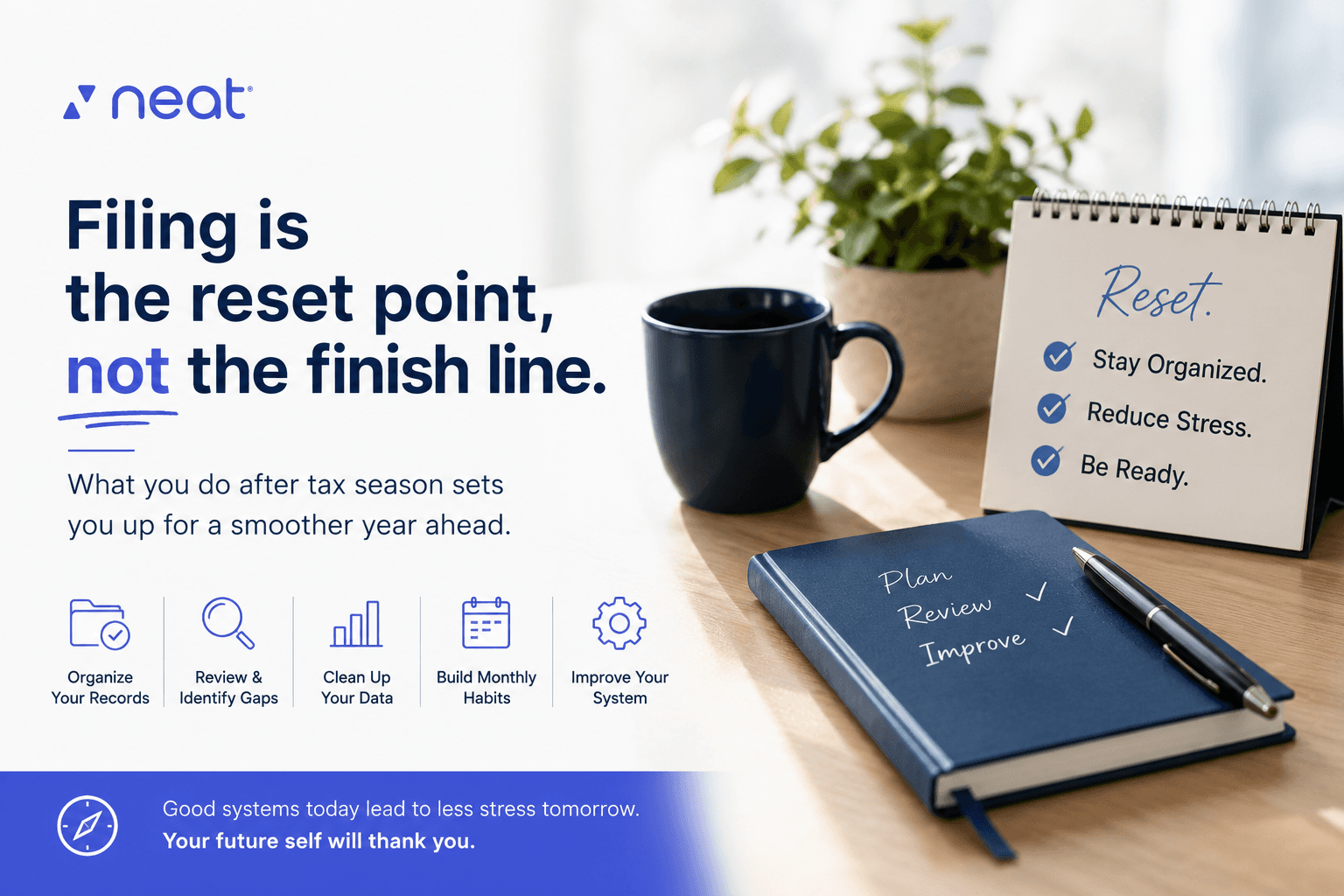
Filing your taxes is not the finish line. It is the reset point. The most important thing you can do after filing is organize your records, review what went wrong, and improve your expense management system. This ensures you stay accurate, reduce stress, and avoid scrambling next tax season.
The Mistake Most Businesses Make After Filing
You finally file your taxes.
There is relief. Maybe even a sense of closure.
And then you move on.
That is the mistake.
Because what you do immediately after filing taxes determines how difficult next year will be.
Most business owners treat tax season like a one-time event. In reality, it is the result of everything that happened throughout the year.
If your process was stressful, time-consuming, or uncertain, that is not normal.
It is a signal your system needs to change.
Step One: Lock In Your Records While Everything Is Fresh
Right after filing is the best time to organize your financial records.
Everything is still recent. You remember what expenses were for. You know where documents are.
This is when you should make sure your receipts, reports, and tax documents are stored in one place.
If something felt hard to find during filing, fix that now.
Because six months from now, it will only be harder.
This is also where proper documentation matters. If you are unsure what should be saved or how detailed your records need to be, then check out:
→ What Does the IRS Consider a Valid Receipt?
Strong recordkeeping is the foundation of effective expense management.
Step Two: Identify What Made Tax Season Difficult
Before you move on, take a few minutes to reflect.
Where did things slow down?
What took longer than it should have?
What information was missing?
For many businesses, the answer comes down to the same issues.
Receipts were scattered.
Expenses were uncategorized.
Reports were incomplete.
These are not tax problems.
They are expense management problems.
And if they are not addressed now, they will show up again next year.
If this sounds familiar, it is worth revisiting:
→ The Hidden Cost of “I’ll Log It Later” in Small Business Finances
Because delays during the year create pressure at tax time.
Step Three: Clean Up Your Current Financial Data
Do not wait until next year to start fresh.
Start now.
Make sure your expense categories are accurate and consistent. Review your recent transactions and confirm everything is properly categorized. If something feels unclear, fix it while the context is still fresh.
This is also a good time to simplify your structure. Too many categories can be just as problematic as too few.
If you want a deeper understanding of how categories impact your finances, Check out:
→ Expense Categories Explained: Why They Matter More Than You Think
Because clean data now means less work later.
Step Four: Set a Monthly Review Habit
One of the biggest differences between stressful tax seasons and smooth ones is consistency.
Businesses that review their finances monthly rarely scramble at year-end.
Why?
Because issues are caught early.
A missing receipt is handled immediately. A miscategorized expense is corrected before it compounds. Reports stay accurate all year.
If you do not already have a process, this is the time to create one. Even a short monthly review can make a significant difference. Check out How to Run a 10-Minute Monthly Financial Review
Because small, consistent actions prevent large problems.
Step Five: Upgrade Your Expense Management System
If filing your taxes felt harder than it should have, your system is the problem.
Not your effort.
Not your discipline.
Your tools.
Modern expense management should reduce work, not create it. Receipts should be captured automatically. Transactions should be categorized in real time. Reports should be available without manual cleanup.
When your system works, tax season becomes a confirmation process, not a reconstruction project.
What This Looks Like in Real Life
A small business owner spent over 15 hours preparing their taxes this year.
Most of that time was not spent filing.
It was spent finding receipts, correcting categories, and verifying numbers.
After filing, they made one change.
They implemented a consistent expense management process with monthly reviews and real-time capture.
The following year, their tax prep took a fraction of the time.
Not because taxes got easier.
Because their system improved.
The Bottom Line
Filing your taxes is not the end of the process.
It is the starting point for doing it better next year.
If you take the time now to organize, review, and improve your expense management, you will save time, reduce stress, and make better financial decisions all year long.
If you want next tax season to feel simple instead of stressful, it starts with better expense management today.
Start your free trial and build a system that keeps you organized all year.
Share This Article


Popular

September 23rd, 2026

March 9th, 2022


June 26th, 2020


October 2nd, 2026