
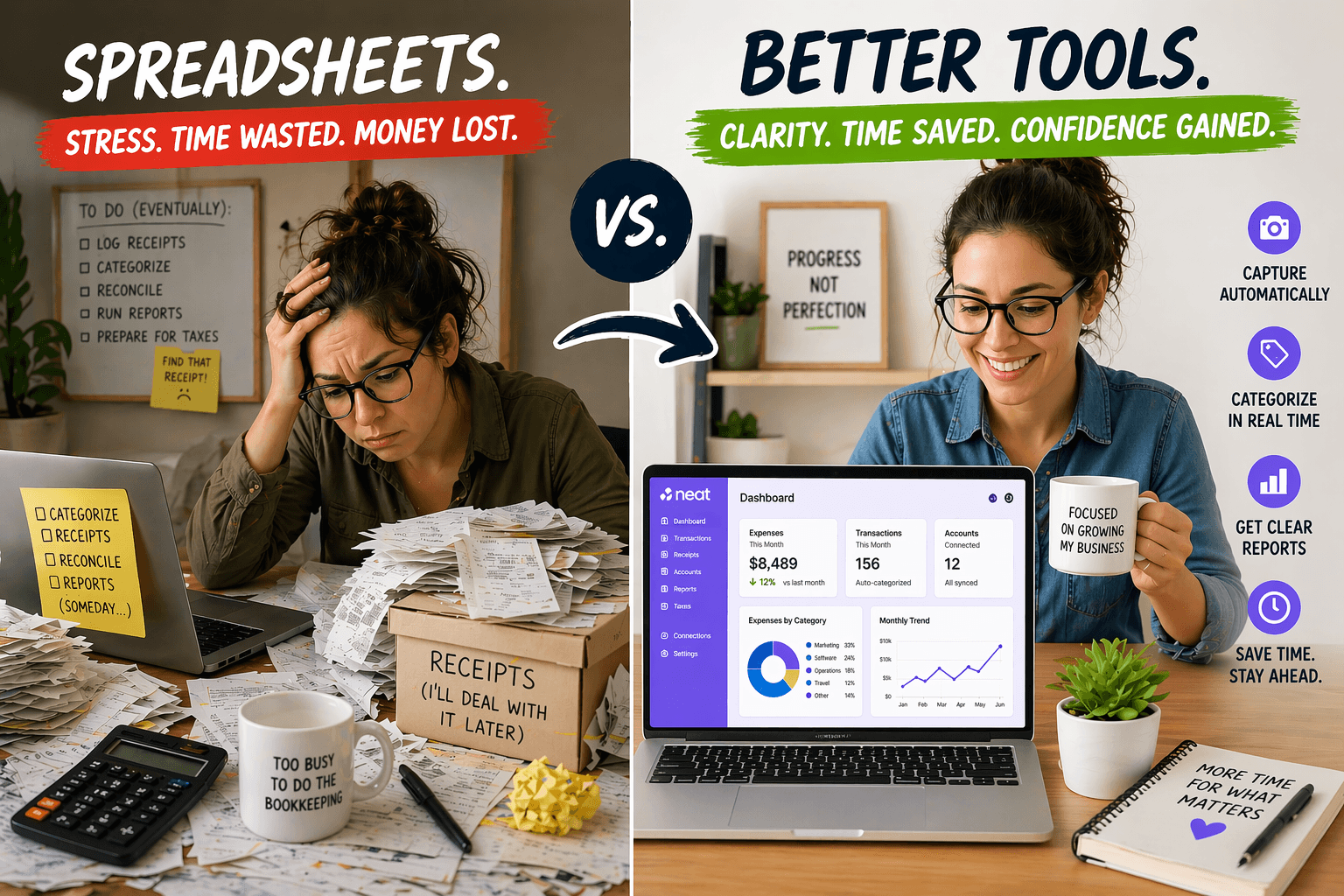
Small businesses are expected to operate with the same financial discipline as large companies, but without the same tools or support. Poor expense management systems create unnecessary stress, wasted time, and lost money. Better financial tools are not a luxury. They are essential for accuracy, visibility, and growth.
Small Businesses Are Expected to Do More With Less
Run the business.
Manage customers.
Handle operations.
Stay compliant.
Prepare for taxes.
And somewhere in the middle of all of that, you are expected to maintain perfect financial records.
Most small business owners are not failing because they lack discipline.
They are working with tools that were never designed for how they actually operate.
The Reality of “Good Enough” Financial Tools
For many businesses, financial management starts with what is avilable.
A spreadsheet.
A folder of receipts.
An inbox full of confirmations
At first, it works.
Then the business grows,
More transactions. More accounts. More complexity.
What once felt manageable starts to break down. Expense management becomes reactive instead of proactive. Instead of having clarity, you are piecing together information from multiple places.
And that is where the problems begin.
The Hidden Cost of Outdated Systems
Poor financial tools do not just create an inconvenience.
They create a risk.
When expense management is inconsistent, small gaps start to form. A receipt is missed. A transaction is miscategorized. A subscription continues unnoticed.
Individually, these are minor.,
But over time, they impact your reporting, you tax position, and confidence in your numbers.
This is the same pattern explored in ‘The Hidden Cost of Waiting Until Year-End To Get Organized‘, where small delays turn into real financial loss.
The issue is not effor.
It is that the system requires too much of it.
Why Small Businesses are Underserved
Most financial tools fall into one of two categories.
They are either too simple or too complex.
Simple tools lack automation, forcing you to manually track and organize everything. Complex tools assume you have a finance team to manage them.
Small businesses sit in the middle.
You need something powerful enough to handle real financial workflows, but simple enough to use daily without friction.
That gap is where most frustration lives.
What Better Expense Management Should Look Like
Better tools do not just store information.
They reduce effort and increase clarity.
Expense management should work the way your business actually runs. Receipts should not live in five different places. Transactions should not sit uncategorized for weeks. Reports should not require hours to build.
Instead, everything should flow together.
Receipts are captured as they happen, whether from mobile, email, or imports. Data is extracted automatically, reducing manual entry. Transactions are categorized in real time, so your reports reflect reality, not esitmates.
When this happens, your financial system stops being a burden and starts becoming a source of truth.
The Difference It Makes in Real Life
A small business owner running a retail operation was spending several hours each month preparing for basic financial reviews. Receipts were stored across email, paper, and phone photos. Transactions were categorized inconsistently. Reports required manual cleanup before they could be used.
After moving to a centralized expense management system, that same review process took less than 15 minutes. More importantly, they discovered recurring charges they had overlooked and identified areas of overspending that were previously hidden.
The time savings mattered.
But the visibility mattered more,
Better Tools Lead to Better Decisions
When your financial data is accurate and up to date, decision-making becomes easier.
You know where your money is going.
You know what is driving costs.
You know where you can adjust.
Without that visibility, every decision carries uncertainty.
This is why organization is not just about tax preparation. It is about running a better business overall. If you want to explore that connection further, a natural place to start is by taking a look at ‘The Real Cost of Bad Expense Tracking (Hint It’s Not Just Money)’
Small Businesses Deserve More Than Workarounds
Too many business owners are forced to rely on habits instead of systems.
They create workarounds to compensate for tools that fall short.
That is not sustainable.
And it is not necessary.
Technology has evolved. Expense management can now be automated, streamlined, and integrated into your daily workflow.
The expectation should not be that you work harder to stay organized.
The expectation should be that your tools do more of the work for you.
The Bottom Line
Small businesses are held to high financial standards.
You are expected to be accurate, organized, and prepared at all times.
You deserve tools that make that possible.
If your current system creates friction, delays, or uncertainty, it is not just inconvenient. It is limiting your ability to operate efficiently and grow confidently.
Better expense management is not a luxury.
It is a requirement for running a modern business.
So if your current tools are slowing you down instead of supporting you, it is time to upgrade your expense management system. Start your free trial of Neat and experience what financial clarity should feel like.
Share This Article


Popular

September 23rd, 2026

March 9th, 2022


June 26th, 2020


October 2nd, 2026